One promise. Four decisions.
One box in your datacenter can't lie to you. Each decision below is a test, not a slide.
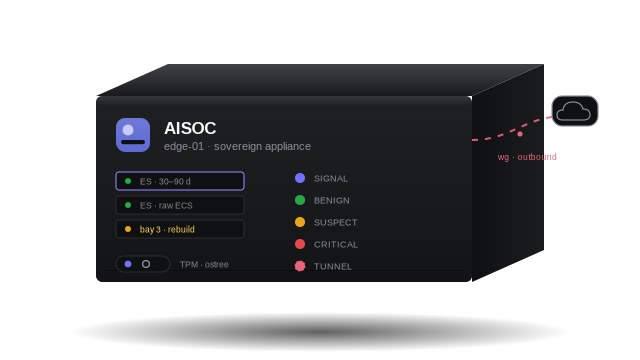
 D1 — One contract, in writing
The only promise that may never break: published source in this repository, versioned, and it only ever grows. Check it: read the proto.
syntax = "proto3";
package soc.tunnel.v1;message TunnelFrame {
  string frame_id = 1;
  uint64 seq      = 2;
  oneof payload {
    AlertMetadataPush    alert   = 10;
    EsqlRequest          query   = 11;
    EsqlResult           result  = 12;
    ContainmentDirective action  = 13;
    ContainmentReceipt   receipt = 14;
  }
}
 D2 — Your data can't escape
"Zero inbound ports, raw logs never leave the box" is a test, not a claim: a port scan finds nothing listening, and outbound traffic shows one tunnel, an allowlist, and nothing else. The portal itself has no front door on the public internet: it is reached through the box, tailnet-only, with analyst sign-in and no self-service registration. Check it: run the checks in your own subnet.
Prove it from your own subnet
The checks ship with the Box: nmap -sT finds nothing listening; a 24-hour tcpdump shows the tunnel plus allowlisted HTTPS only.
| check | method | result |
|---|---|---|
| inbound listeners | nmap -sT box/32 | 0 found |
| egress classes | tcpdump 24h | tunnel + allowlist only |
| raw events in frames | schema fuzz ×10k | 0 leaks |
 D3 — The AI, on a leash
Every action is checked by the same rules at both ends. The safe ones run on their own, within your limits; the risky ones wait for a named human — and no human can approve what the rules forbid. Your box's check is independent, so a compromised cloud can't force an action. Check it: 18 of 18 pass on every build.
 D4 — Customers kept apart
Row-level security — the database locks each customer's rows — is the load-bearing wall: queries run as one customer, our code never connects as admin. Search runs on per-customer indices, checked at the edge. Check it: cross-customer reads return ∅; out-of-scope is 404, never 403.
Underneath all four: the ledger
Every prompt, query, verdict, approval, and receipt lands in a ledger that only grows — each entry with a receipt trail to the original event, verifiable without trusting us. The ledger is the chain builder's: SHA-256(canonical_json(event) || prev_hash), genesis all-zeros (apps/agent-orchestrator/src/orchestrator/audit_chain.py); the four crossing kinds it records — alert metadata, query, signed directive, receipt — are the TunnelFrame v1 payloads (proto/soc/tunnel/v1/payloads.proto), each stamped with an edge_audit_ref.
Agentic operations — the loop, end to end
The four decisions define what the box is; this is what runs inside it. One loop: the AI proposes, the rules decide, a named human signs what is risky, and every step lands in the ledger. Each stage is labeled with where it stands today — the status labels match the Torq parity audit (docs/marketing-audit-torq-parity.md), which checked every claim against code and spec.
| Stage | What happens | Status |
|---|---|---|
| Triage | The alert becomes a verdict: ranked hypotheses with the reasoning behind them — under 90 seconds, in the reference stack. | shipped today |
| Investigation | A bounded set of pre-checked queries runs against your own box — capped per run, validated before dispatch. It is evidence-driven triage; open-ended "hunting" is not claimed. | shipped today |
| Evidence | The queries it ran and the knowledge it cited — ATT&CK, SOPs, incident records — attach to the case. Every verdict shows its work. | shipped today |
| Case summary | A written summary of the case, each claim pointing at its evidence — the handoff for the next shift. | on spec, next |
| Approval | Actions the policy allows run alone; the risky ones wait for a named human with MFA. A human cannot approve what policy forbids — 18 of 18 checks, including the negative controls, on every build. | shipped today |
| Action + receipt | Five action classes, each signed, re-checked by the same rules on your box before it runs, and receipted back into the ledger. | shipped today |
The next stage is the analyst: a read-only assistant that answers from your own data, tenant-scoped, with citations — specified, not yet built. It answers; it can never trigger containment.
The loop also feeds metrics you can pull: time-to-detect and time-to-resolve, case and alert volume, computed live from your own rows via the API. Scheduled exports and executive reports are on spec — not yet built.
What it deliberately is not
- Not a team of customizable agents. One deterministic graph; routing is a pure function of validated state, not a fleet you can prompt into new roles. The AI proposes; a published rules file decides. You can read both.
- Not a workflow builder. The automation surface is a decision table — 18 of 18 checked on every build — not a canvas where anything can be drawn.
- Not 300 integrations. Eight telemetry surfaces, listed on the front page. If yours isn't on the list, we tell you.
- Not a percentage. Autonomy is a tier — standard, restricted, or manual-only — set per customer. No "% auto-remediated" figure, because none is measured.
- Not a brain that learns. Every decision is recorded, citable, and verifiable. Recording is shipped; learning is not claimed.
What the gates prove
- Gate G1 — sovereignty. One open port, one cross-tenant row, or one foreign cert fails the build.
- Gate G2 — five promises. The check never varies, risky waits for a human, approvals are in the ledger, the AI can't inject, the log can't be edited.
- Held on every build. 18/18 policy, 17/17 triage, plus a docs-match-the-code check.
Plain answers
What is the "contract", really?
The published file that defines what may cross between your network and ours — versioned, only ever grows.
Can the cloud force my box?
No. The same rules re-run, independently, on your box. A compromised cloud can suggest — it can't command.
Does the AI act on its own?
Within the autonomy tier you set, some actions run without a human — the published policy file says exactly which. The risky ones always wait for a named approval with MFA, and the same rules re-run on your box before anything executes.
What's in the audit ledger?
Everything that happens — prompts, queries, verdicts, approvals, receipts — in an order that can't be rewritten, with a receipt trail to the source event.
Deeper: Architecture · Tunnel protocol and policy in the spec · API surface